

Solar Panel Installation in Marbella: A Step-by-Step Guide
Installing a solar power system on a villa in Marbella is not comparable to purchasing a household appliance — it is the implementation of a comprehensive engineering solution. For solar panels to genuinely reduce electricity bills, deliver a reasonable return on investment and operate efficiently for 20–30 years, the entire process must be carefully structured and executed in clearly defined stages.
Why Install Solar Panels in Marbella?
In Andalusia, where solar irradiation levels are among the highest in Europe, a private solar power installation is not merely an экологически responsible choice, but a financially sound investment.
Reduction of Operating Costs
Covering the property’s base energy consumption — including climate control, pool heating, lighting and household appliances — through on-site power generation.
Energy Security
Backup power functionality in the event of grid failures or supply instability.
Increased Available Capacity
In areas where grid connection capacity is limited, a solar system combined with energy storage can effectively expand the property’s usable power supply.
Enhanced Property Value
Energy efficiency and on-site generation significantly increase the investment appeal of a villa on the Costa del Sol.
Stage 1: Property Assessment and Site Selection
The design phase begins with a detailed technical inspection. Several critical factors must be evaluated:
· Roof load-bearing capacity: the structure must support the weight of photovoltaic modules, mounting systems and regional wind loads.
· Shadow analysis: identifying elements that may obstruct direct sunlight (chimneys, trees, neighbouring buildings). Even partial shading of a single module can reduce the performance of an entire string in a series-connected system.


Stage 2: Engineering Design and System Calculation
At this stage, the optimal system configuration is determined.
Panel Tilt Angle
In the Marbella region, calculations are based on year-round performance rather than peak summer output. The primary objective is to ensure stable generation during winter months.
Orientation
South-facing installations typically deliver maximum efficiency. However, when battery storage is included, east–west configurations may be considered to distribute generation more evenly throughout the day.
System Capacity Calculation
Output capacity is determined based on the property’s actual annual energy consumption (kWh), rather than estimated or approximate figures.
Stage 3: Equipment Selection
A solar power system consists of key components that must be carefully specified for each individual property:
Photovoltaic modules (solar panels): degradation rate and long-term performance warranties are critically assessed.
Inverter: preference is given to modern models that allow performance monitoring at string or module level.
Energy storage systems (batteries): capacity is calculated according to nighttime consumption, backup requirements and priority loads.
Stage 4: Installation and Integration into the Smart Home System
A crucial aspect of installation is the correct integration of the solar system into the property’s overall engineering infrastructure. As mentioned previously, mounting systems are selected according to roof type and wind exposure, while sealing solutions are implemented to eliminate long-term leakage risks.
Following physical installation, software configuration begins. The solar installation must operate not as an isolated system, but as part of a unified smart home management platform. At this stage, intelligent consumption logic is programmed. High-demand activities — such as electric vehicle charging, pool filtration or water heating — can be automatically scheduled during peak solar generation hours. This maximises self-consumption and reduces reliance on grid electricity.
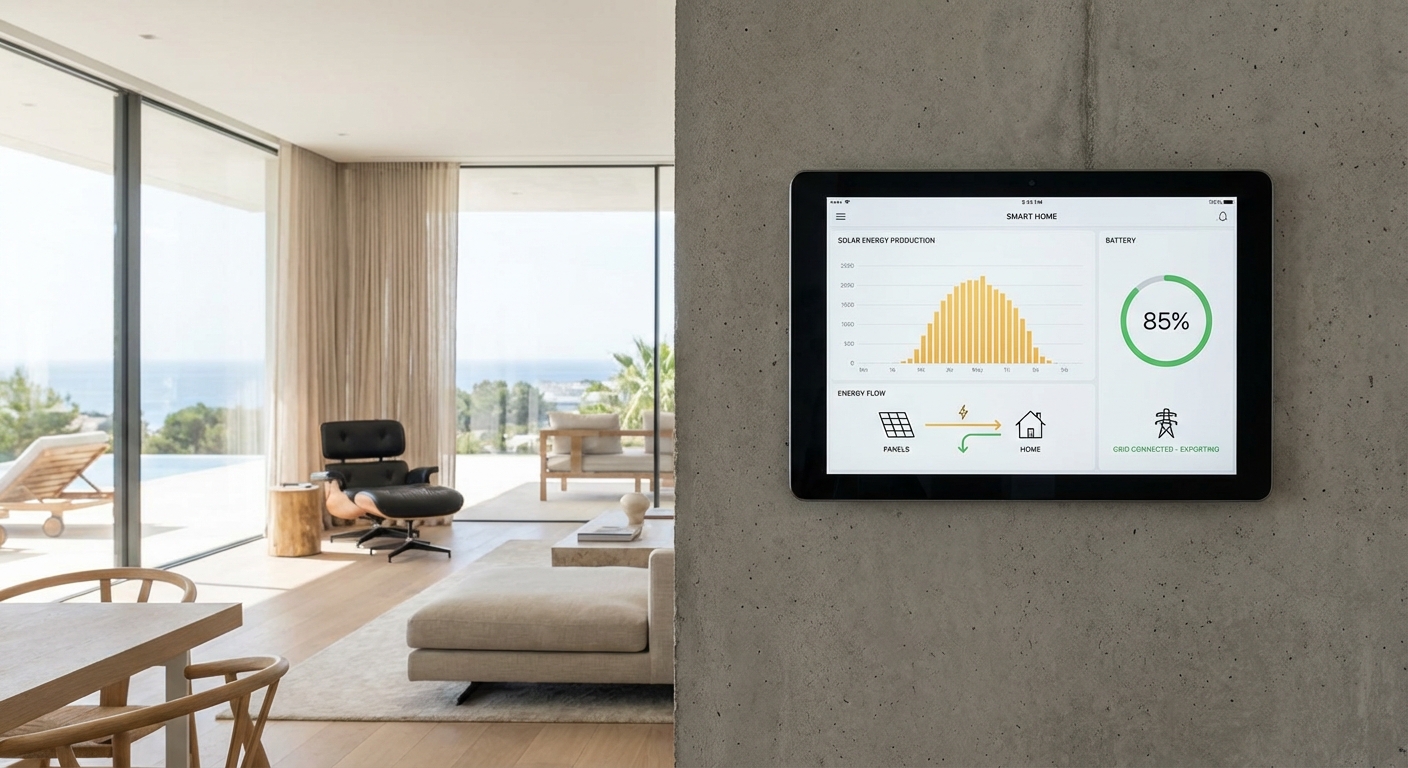
A real-time monitoring system is also configured. The homeowner gains access to a unified interface displaying generation output, current consumption, battery charge levels and overall system performance statistics. Such visibility not only enables performance tracking but also allows prompt response to any irregularities.
Proper integration into the smart home ecosystem ensures predictable, controllable and highly efficient energy management tailored to the specific климатические conditions of the region.
Stage 5: Legalisation and Grid Connection
The final stage involves both technical and regulatory procedures:
· Preparation of project documentation for municipal authorities
· Coordination with the electricity provider
· Grid connection with surplus energy compensation (net billing)
· System registration to qualify for applicable tax incentives (including potential IBI reductions under municipal programmes)
How to Implement a Solar Power System Without Risk?
Errors at the calculation or installation stage may result in:
· Roof leaks
· Equipment overheating
· Refusal of system registration
· Reduced actual energy output
A comprehensive, professionally managed approach minimises these risks and ensures a predictable return on investment.
UNCOM delivers a complete turnkey solution:
· Property assessment and site selection
· Calculation of orientation and tilt angle
· Equipment specification (panels, inverters, batteries)
· Procurement and installation
· Legalisation of the system
· Grid connection
· Integration into the smart home platform
· Energy storage solutions (backup / off-grid)
The result is an autonomous, energy-efficient and fully compliant solar power system, specifically engineered for the climate and operational conditions of the region.
